

Recognition Isn’t a Program. It’s a Leadership Habit.
It's the least expensive and often most effective way of getting employees engaged.


We may be past the peak of the Great Resignation, but that doesn’t mean the workforce has stabilized. In many organizations, something quieter—and potentially more damaging—has taken its place.
Employees aren’t leaving. They’re staying. But many are doing so with reduced energy, diminished commitment, and little connection to the work beyond what’s required. They show up, complete their tasks, and collect a paycheck, but the sense of ownership and engagement that once differentiated great performance has faded.
A few years ago, many of these employees would have left for another opportunity. Today, uncertainty in the job market and greater risk aversion have changed that dynamic. Instead of leaving, people are staying put—often disengaged, but not visibly so.
This creates a misleading picture for leaders. Lower turnover can look like a win, even when it masks a deeper problem. Retention should mean holding on to strong contributors while addressing marginal performance. When everyone stays, including those who have quietly checked out, retention becomes a weak indicator of organizational health.
The most challenging group to identify isn’t the actively disengaged. It’s the large middle—employees who are neither fully engaged nor openly disengaged. Gallup’s recent engagement data highlights this clearly: roughly one-third of employees are engaged, a smaller percentage are actively disengaged, and more than half fall somewhere in between.
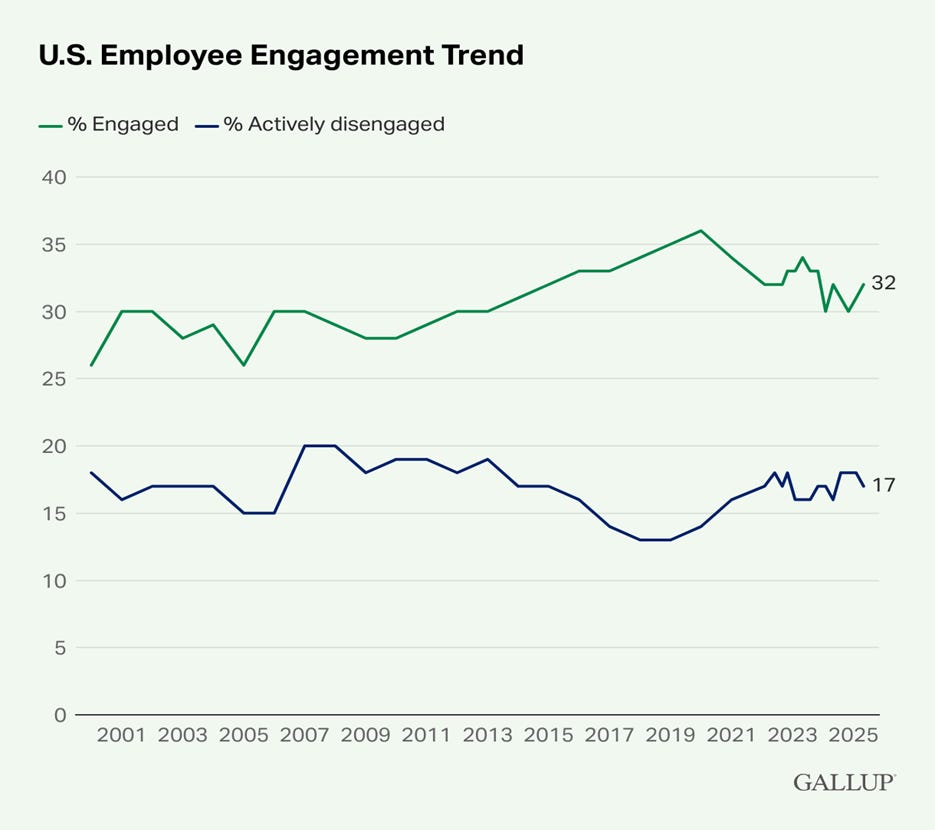
I’ve come to think of this middle group as The Big Stay, and it’s one of the most misunderstood challenges leaders face right now.
What makes The Big Stay difficult is that disengagement doesn’t announce itself. It doesn’t arrive as a resignation letter or a dramatic confrontation. It shows up as indifference, quiet withdrawal, and a gradual erosion of discretionary effort.
One of the most effective ways to counter this erosion is also one of the most overlooked.
Recognition.
The Recognition Gap
Gallup’s additional data is equally revealing. Only about one in three U.S. employees strongly agree they’ve received recognition or praise for doing good work in the past seven days. That means most employees are moving through their workweek unsure whether their effort is noticed or valued.
When recognition is absent, people don’t disengage all at once. They adapt. They stop offering ideas. They stop stretching. They stop investing emotionally in the outcome. Over time, work becomes transactional rather than meaningful.
When done well, recognition interrupts that drift. Not because it creates temporary good feelings, but because it reinforces something more fundamental: that the work matters and the effort is seen.
Why Recognition Works
Effective recognition does more than acknowledge effort. It clarifies expectations. When leaders recognize specific behaviors, they communicate what success looks like and what the organization truly values.
Recognition also strengthens trust. Employees are more willing to accept feedback, take on stretch assignments, and adjust their behavior when they believe their leader is paying attention. Recognition signals awareness, and awareness builds credibility.
Finally, recognition fosters connection. People are far more likely to remain engaged in environments where they feel seen and appreciated by the leaders they work with most closely.
This is why recognition is so closely tied to engagement, retention, and performance. It isn’t a soft skill. It’s a leadership one.
Why Leaders Struggle With It
Most leaders don’t resist recognition because they don’t believe in it. They resist it because it feels awkward, uncomfortable, or easy to overlook amid competing demands. Some worry recognition will sound insincere. Others assume it should be reserved for major accomplishments. Many simply don’t know how to do it well.
A few explanations come up repeatedly:
There’s no time to do it.
It will feel forced or fake.
With everything else going on, it’s easy to forget.
In reality, recognition doesn’t require much time, and it doesn’t require exaggeration. It requires attention. The most meaningful recognition is specific, timely, and grounded in real contributions. Done well, it doesn’t lower standards—it reinforces them.
Recognition Isn’t a Program
One of the most common mistakes organizations make is trying to formalize recognition before leaders know how to deliver it well. When recognition becomes a program rather than a practice, it often loses its impact.
Pizza parties, gift cards, and employee-of-the-month awards rarely change behavior or build connection. What does make a difference is personal recognition delivered by leaders whose opinions carry weight.
When a manager takes the time to say, “Here’s what you did, here’s why it mattered, and here’s the impact it had,” employees pay attention. More importantly, they remember.
Years ago, I was a mid-level manager taking over a new team. One of the sales representatives, Roy, had been struggling for several months. My manager offered simple advice: find a reason to praise him.
At first, that felt like a stretch. But then I overheard Roy handling a client conversation with exceptional care and professionalism. At the next team meeting, I called out that specific interaction and explained why it mattered.
Roy didn’t transform overnight, but something shifted. He became more engaged, more confident, and gradually more effective. Recognition didn’t excuse poor performance—it created the conditions for improvement.
Recognition works when it feels earned and personal, not generic or automatic.
Building the Habit
A culture of recognition isn’t created through policy. It’s created through repetition. Leaders who do this well build recognition into the rhythm of their work.
They acknowledge contributions in meetings.
They reinforce progress in one-on-one conversations.
They recognize effort, not just outcomes.
They notice the people who don’t ask to be noticed.
Over time, recognition becomes part of how work gets done. Employees don’t wonder whether their efforts matter. They know.
A Final Thought
Recognition is one of the simplest tools leaders have and one of the most powerful. It costs nothing, requires no formal approval, and can be delivered in moments. Yet its impact on engagement, trust, and performance is significant.
Not because recognition is a program.
But because it’s a habit.
And like most leadership habits, it starts with paying attention—and remembering to say thank you when the work is done well.
Just so you know, I personally write each one of my posts. There’s no AI or ghostwriter here; it’s just me. (But I am using AI to find links to my previous posts!)